
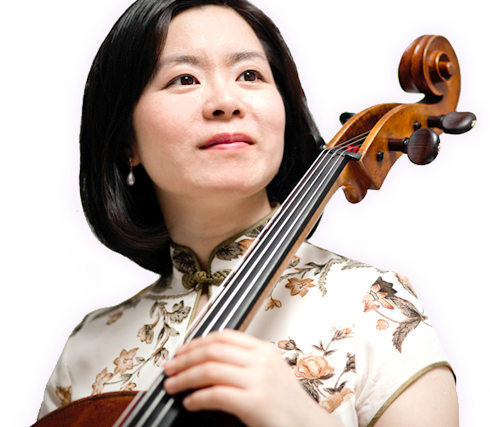
Biography
An exceptional musician renowned for her fluid technique, gorgeous tone, and brilliant, expressive performances, cellist Hai-Ye Ni enjoys a distinguished, multi-faceted career as principal cellist of the acclaimed Philadelphia Orchestra, and as a sought-after soloist and chamber musician.
A versatile artist whose performances have been praised by the press as "soulfully expressive" (Washington Post) and possessing a "superbly focused sound" (San Francisco Chronicle), Ms. Ni has performed on classical stages around the world, appearing as soloist with such symphony orchestras as Chicago, New York Philharmonic, San Francisco, Vienna Chamber Orchestra, Vancouver, Singapore, the Orchestre National de Paris, Finnish Radio Symphony Orchestra, the Shanghai Symphony, China Philharmonic, and Hong Kong Philharmonic, among others.
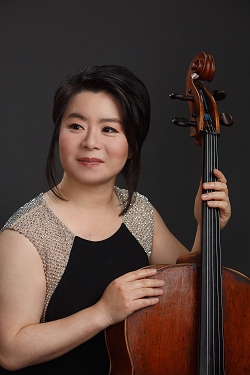 Her recital credits include the Lincoln Center New York, Kennedy Center for the Performing Arts, the Smithsonian Institute, Gardner Museum, Philadelphia Chamber Music Society, and the Wallace Collection in London. She has collaborated with some of today's foremost artists, including pianists Jean-Yves Thibaudet, Lang Lang, Jeffrey Kahane, and Yefim Bronfman, and violinists Joshua Bell, Gil Shaham, Christian Tetzlaff, and Pinchas Zukerman. Among her festival credits are Ravinia, Marlboro, La Jolla SummerFest, Sarasota, Chamber Music Dolomiti (Italy), Pacific Music Festival, Santa Fe, Aspen, Spoleto, Kuhmo, and Pablo Casals (France).
In 2024, Ms. Ni played a recital tour in China, and in the summer, and performed at the Chamber Music Dolomites festival in Italy.
In 2023, she gave a recital at the New England Conservatory, and performed the Barber concerto with the Apollo Orchestra in Washington, DC. Hai-Ye made her solo debut with the Philadelphia Orchestra in 2010 in Saint-Sa&eml;ëns concerto with Maestro Rafael Frühbeck de Burgos. She was also featured in Haydn C major concerto, Tan Dun's The Map Concerto for Cello, Video and Orchestra, Tchaikovsky Rococo Variations; the Brahms "Double" Concerto, and the Beethoven "Triple" Concerto.
Highlights of Hai-Ye's past performances include an All Baroque Concertos program with the Philadelphia Chamber Orchestra as soloist and conductor. She also played trio with Lang Lang in 2009 at Carnegie for Ancient Paths, Modern Voices: A Festival Celebrating Chinese Culture. In 1997, Ms. Ni premiered composer Bright Sheng's cello concerto Two Poems in a 14-city U.S. tour, in which she replaced cellist Yo-Yo Ma at his recommendation.
As a recording artist, Hai-Ye Ni's solo CD on Naxos in 1998 was named CD of the week by Classic FM London. Her CD Spirit of Chimes with violinist Cho-Liang Lin and pianist Helen Huang on Delos is of composer Zhou Long's chamber music. Ms. Ni is featured on the 2008 Ondine Shostakovich recording of the Philadelphia Orchestra and Christoph Eschenbach.
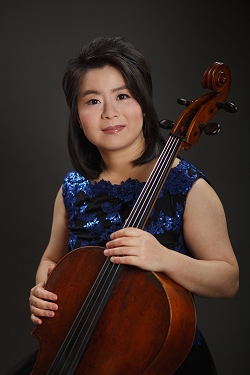 Ms. Ni was a jury member of the V Paulo International Cello competition in Helsinki, Finland in April 2013, and has given masterclasses at Curtis, Temple University, Mannes School, Manhattan School of Music, Yong Siew Toh Conservatory of Music (Singapore), the Shanghai Conservatory, and the Central Conservatory in Beijing. She was on the faculty of Rutgers University, and was a visiting professor at the Shanghai Conservatory. Ms. Ni has also been featured on the ABC television show 20/20, NPR, The Strad magazine, and has been the cover story of Strings magazine.
Considered among the most accomplished cellists of her generation, Ms. Ni first came to national attention in 1990 when she won first prize at the Naumburg International Cello Competition, and as a result, made her greatly acclaimed Alice Tully Hall debut in 1991. She became principal cellist of the Philadelphia Orchestra in 2006. Prior to that, Ms. Ni held the position of associate principal cellist of the New York Philharmonic (1999-2006), and was also a member of the Chamber Music Society of Lincoln Center's Chamber Music Society Two. Other honors and awards to her credit include a 2001 Avery Fisher Career Grant, second prize in the 1997 Rostropovich Competition (France), first prize in the 1996 International Paulo Cello Competition (Finland), and the 1994 Best Performance of Tchaikovsky prize at the International Tchaikovsky Competition (Russia).
Hai-Ye Ni was born in Shanghai, China and began her cello studies with her mother and the Shanghai Conservatory of Music. She also studied with Irene Sharp at the San Francisco Conservatory of Music, Joel Krosnick at The Juilliard School, and with William Pleeth in London.